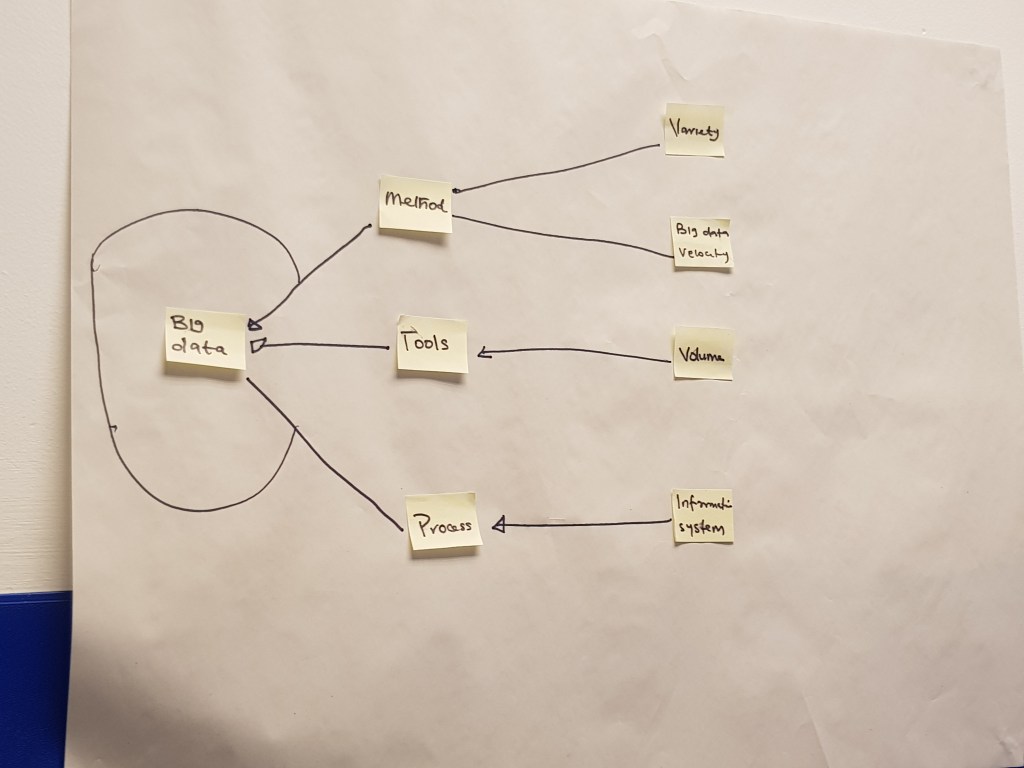
During this class activity we discussed how the value chain plays a role within a businesses information systems and management. Further we also discussed Porters five forces that similarly t systems thinking contain all activities required for bringing the final service or product to the final customer. Furthermore we conducted an activity in groups higlighting how information systems create value. The above is what we came up with in class. Here you can see that the value chain of a business begins with information systems. Technolgy allows businesses to efficiently put processes in place which is the connection between information systems and bid data. The final step of big data is where the value is created in the businesses value chain as all the data collected can be used by the business to offer specific products or services. Hence, individual value chain is there for every firm, subset of supply chain. During class we learned that Porter’s value chain has two sections. Lower section has the activities which are sequentially organised same as production line. Hence, initial step is inbound logistics, leading to the operations of manufacturing, outbound logistics, sales and marketing and finally service (Bustinza et. al. 2015). It is caricature of value chain of each firm and would contain separate headings as per the operations’ nature.
Value is total amount which the buyers would pay for service or product which is provided by the firm. There is alteration in profit when value produced by firm exceeds cost to provide it. It is the strategy’s goal and therefore creation of value becomes an essential factor in the competitive analysis. We discussed how each activity of value employs costs like raw materials along with other purchased materials and human resources. Every activity of value creates information which can be seen in the image above highlighted big data. This is required for establishing the current status and direction of business. Value could be created by reduction in stocks and accounts receivable while value could be lost by purchases of raw materials and all other liabilities. These activities could be classified in either support or primary activities (Holweg and Helo 2014). We looked at how each of the categories is divided into few specific activities which vary as per the organisations and the strategy chosen by the firms.

During class we found that value chain gave good basis which could be used for conducting cost analysis. Principle advantages of it is that value chain’s elements are organised already around the issues which are crucial for having profitability and competitive advantage. Criticism of costs analysis was difficult to define analysis’s correct units, an issue that was solved by value chain brilliantly (Mol 2015). Hence, normal procedure of cost analysis could take place by defining those elements which relate to competitive advantage’s sources, establishing different activities and relative importance in the product’s total cost.
In our group I learned that the concept of value chain helps in identifying detailed cost behaviour. Action’s separate strategic courses should be identified for developing differentiation and sensitive, less priced strategies. Competitive advantage could be achieved through strategic activities cheaper or better than competitors. Comparison between different competitors’ value chains identifies ways to achieve strategic advantage through reconfiguring individual firm’s value chain (Antràs and Chor 2013). Overall this activity taught me that reconfiguration of value chain is used often by competitors to achieve competitive advantage. Successful strategies of reconfiguration occur usually by moves such as process of new production, indirect verses direct sales strategy, automation differences, opening of distribution channels and latest advertising media.

References
Antràs, P. and Chor, D., 2013. Organizing the global value chain. Econometrica, 81(6), pp.2127-2204.
Bustinza, O.F., Bigdeli, A.Z., Baines, T. and Elliot, C., 2015. Servitization and competitive advantage: the importance of organizational structure and value chain position. Research-Technology Management, 58(5), pp.53-60.
Holweg, M. and Helo, P., 2014. Defining value chain architectures: Linking strategic value creation to operational supply chain design. International Journal of Production Economics, 147, pp.230-238.
Mol, A.P., 2015. Transparency and value chain sustainability. Journal of Cleaner Production, 107, pp.154-161.
 mohammed ali almakhalas msc blog