Be yourself; Everyone else is already taken.
— Oscar Wilde.
This is the first post on my new blog. I’m just getting this new blog going, so stay tuned for more. Subscribe below to get notified when I post new updates.
Be yourself; Everyone else is already taken.
— Oscar Wilde.
This is the first post on my new blog. I’m just getting this new blog going, so stay tuned for more. Subscribe below to get notified when I post new updates.

This blog is on the following article about system thinkinghttps://www.forbes.com/sites/forbeshumanresourcescouncil/2017/10/30/amplify-your-leadership-effectiveness-apply-systems-thinking/#756b0aaf265e. According to this article, it is a way to look at different areas of a business as interconnected, within socio, economic, geopolitical and technical. All these interacting with one another in counterintuitive and interesting ways, hence system thinking is about seeing the world from this kind of meta prospect stepping and viewing larger systems which composed functioning of governments, environments and economies of whole world (Gehlert, Ressler and Baylon 2013).
It is learning about how systems function recognising that specific principles and laws are available which govern systems. These could be learned and studied through analysis, observing and integrating several stuff in aggregate way and learning traps which befall us as we try to alter and manipulate systems. Dr. Albrecht (2017) states in the article that ‘The most powerful outcome of systems thinking is the sustained improvement of output in both efficiency and effectiveness. This therefore assumes that if a business was to implement systems thinking they would be guaranteed to become more efficient and effective. Hartmann and Halecker, (2013) agree with this stating ‘systems thinking offers leaders in management a systematic way of thinking for increased understanding and more effective work’.

Dr. Albrecht (2017) states ‘the best reason for engaging in systems thinking is that it correlates to improved performance’. This is really important as by engaging in system thinking, it will be easier it implement new ideas and changes where otherwise without this it would be difficult to change a system. Studying system thinking is for making positive meaningful impact in businesses. Changing some features of a system is to have some kind of specific impact (Ison and Shelley 2016). Dr. Albrecht (2017) also states ‘It is paramount to be able to evaluate the interrelations of systems, comprehend the forces that are at work on the business and subsequently choose changes that result in improved production both in the near-term and in the long-term.’ This shows that it is crucial for businesses to know what effect or influences their system. Depending on these influences the correct change to the system can be taken and implemented.
According to Dr. Albrecht (2017) ‘the larger the business, the more complex the interactions,’ when it comes to systems thinking. This means that managers and leaders of different departments or section within large businesses must ensure their sub system is fully functional in order to ensure the overall system is effective. Alternativelt Dr. Albrecht (2017) here could be highlighting the difficulty management and business leaders face when managing complex systems.
When the systems are to be changed and manipulated, one of the most important things is that complex system behaves in ways that were not expected and it might create results that are opposing of what was intended. This is really important to learn from for managers according to Dr. Albrecht (2017) and therefore It is important for managers to learn about some systems.

Dr. Albrecht (2017) describes systems thinking as a set of interconnected things, as these systems could be thought of as elements, there are often times physical things and then the relationships are interconnections between these elements. These relationships are usually much less tangible, hence it is harder in dealing with them as they seem sort of abstract and the relationships are much more essential than the elements themselves (Sedarati and Baktash 2017). Systems behave in very complex ways and increase in complexity the more elements and connections are created. The system has a purpose of serving a function and is very important to understand about the function and what the function is about with respect to the system.
References
Albrecht, D. (2017). Amplify Your Leadership Effectiveness: Apply Systems Thinking. [online] Forbes. Available at: https://www.forbes.com/sites/forbeshumanresourcescouncil/2017/10/30/amplify-your-leadership-effectiveness-apply-systems-thinking/#756b0aaf265e [Accessed 19 Nov. 2019].
Gehlert, K.M., Ressler, T. and Baylon, D., 2013. Global challenges demand global education of systems thinking. Human Systems Management, 32(2), pp.79-94.
Ison, R. and Shelley, M., 2016. Governing in the Anthropocene: contributions from systems thinking in practice?. Systems Research and Behavioral Science, 33(5), pp.589-594.
Sedarati, P. and Baktash, A., 2017. Adoption of smart glasses in smart tourism destination: A system thinking approach.

Cloud computing is computing paradigm, in which numerous systems could be connected in private or public networks, for providing dynamically extendable infrastructure to application, data and file storage. With this technology, content storage, computation cost, delivery, and application hosting is reduced significantly. It is practical approach for experiencing direct benefits of cost and has potential in transforming data centre from capital-intensive set up to variable priced environment (Rittinghouse and Ransome 2017). Cloud computing’s idea is about primary principal of IT capabilities’ reusability. The difference which is brought by cloud computing compared to conventional concepts of computing, autonomic computing, grid computing or distributed computing is broadening horizons over the boundaries of the organisation.
Cloud services could be categorised in three categories:

Third parties own and operate public clouds. Public cloud deliver scale’s superior economies to the customers, as costs of infrastructure are spread between several users, giving every client attractive low-cost. Public cloud’s one advantage is they might be larger when compared to enterprises cloud, providing ability for scaling seamlessly (Sadiku, Musa and Momoh 2014). Private clouds are developed for single enterprises. These clouds address concerns about security of data and greater control is offered by them, which is lacking in public cloud.
Enterprises should be aligning their applications for exploiting architecture models which are offered by cloud computing. There are several reasons for attributing cloud technology having lower costs. Maintenance is lowered as infrastructure is not required to be purchased. With massive infrastructure which cloud providers offer today, maintenance and storage of huge data is made easy.

Despite the growing influence of cloud computing, there are concerns about cloud computing. Crucial element which warrants scrutiny is data security. Organisations are reluctant in buying data security’s assurance of business from vendors. Loosing consumers’ data confidentiality and loosing data to rival organisations are the factors which are feared of (Arora, Parashar and Transforming 2013). All applications for businesses have agreements of service level which are followed stringently.
Encryption helps in protecting data, so that the data is not compromised. It provides protection to data which is transferred along with data stores within the cloud. Encryption gives protection to data from unauthorised access and sensitive data is protected from data breaches with the help of this encryption.
References
Arora, R., Parashar, A. and Transforming, C.C.I., 2013. Secure user data in cloud computing using encryption algorithms. International journal of engineering research and applications, 3(4), pp.1922-1926.
Dinh, H.T., Lee, C., Niyato, D. and Wang, P., 2013. A survey of mobile cloud computing: architecture, applications, and approaches. Wireless communications and mobile computing, 13(18), pp.1587-1611.
Rittinghouse, J.W. and Ransome, J.F., 2017. Cloud computing: implementation, management, and security. CRC press.
Sadiku, M.N., Musa, S.M. and Momoh, O.D., 2014. Cloud computing: opportunities and challenges. IEEE potentials, 33(1), pp.34-36.
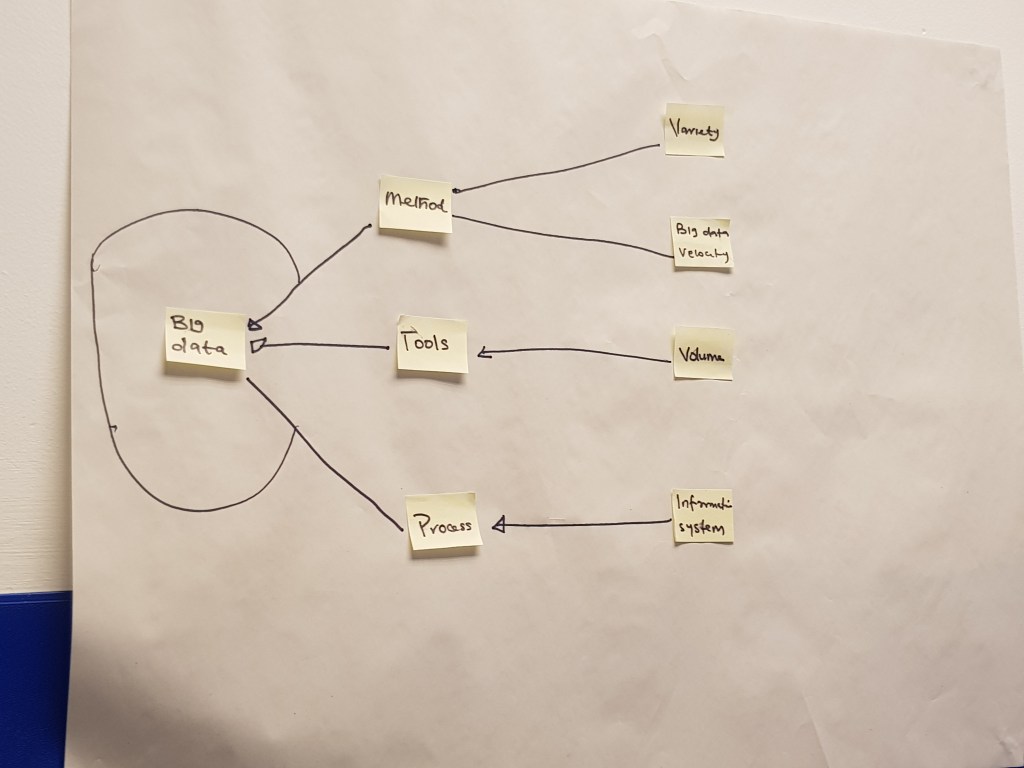
During this class activity we discussed how the value chain plays a role within a businesses information systems and management. Further we also discussed Porters five forces that similarly t systems thinking contain all activities required for bringing the final service or product to the final customer. Furthermore we conducted an activity in groups higlighting how information systems create value. The above is what we came up with in class. Here you can see that the value chain of a business begins with information systems. Technolgy allows businesses to efficiently put processes in place which is the connection between information systems and bid data. The final step of big data is where the value is created in the businesses value chain as all the data collected can be used by the business to offer specific products or services. Hence, individual value chain is there for every firm, subset of supply chain. During class we learned that Porter’s value chain has two sections. Lower section has the activities which are sequentially organised same as production line. Hence, initial step is inbound logistics, leading to the operations of manufacturing, outbound logistics, sales and marketing and finally service (Bustinza et. al. 2015). It is caricature of value chain of each firm and would contain separate headings as per the operations’ nature.
Value is total amount which the buyers would pay for service or product which is provided by the firm. There is alteration in profit when value produced by firm exceeds cost to provide it. It is the strategy’s goal and therefore creation of value becomes an essential factor in the competitive analysis. We discussed how each activity of value employs costs like raw materials along with other purchased materials and human resources. Every activity of value creates information which can be seen in the image above highlighted big data. This is required for establishing the current status and direction of business. Value could be created by reduction in stocks and accounts receivable while value could be lost by purchases of raw materials and all other liabilities. These activities could be classified in either support or primary activities (Holweg and Helo 2014). We looked at how each of the categories is divided into few specific activities which vary as per the organisations and the strategy chosen by the firms.

During class we found that value chain gave good basis which could be used for conducting cost analysis. Principle advantages of it is that value chain’s elements are organised already around the issues which are crucial for having profitability and competitive advantage. Criticism of costs analysis was difficult to define analysis’s correct units, an issue that was solved by value chain brilliantly (Mol 2015). Hence, normal procedure of cost analysis could take place by defining those elements which relate to competitive advantage’s sources, establishing different activities and relative importance in the product’s total cost.
In our group I learned that the concept of value chain helps in identifying detailed cost behaviour. Action’s separate strategic courses should be identified for developing differentiation and sensitive, less priced strategies. Competitive advantage could be achieved through strategic activities cheaper or better than competitors. Comparison between different competitors’ value chains identifies ways to achieve strategic advantage through reconfiguring individual firm’s value chain (Antràs and Chor 2013). Overall this activity taught me that reconfiguration of value chain is used often by competitors to achieve competitive advantage. Successful strategies of reconfiguration occur usually by moves such as process of new production, indirect verses direct sales strategy, automation differences, opening of distribution channels and latest advertising media.

References
Antràs, P. and Chor, D., 2013. Organizing the global value chain. Econometrica, 81(6), pp.2127-2204.
Bustinza, O.F., Bigdeli, A.Z., Baines, T. and Elliot, C., 2015. Servitization and competitive advantage: the importance of organizational structure and value chain position. Research-Technology Management, 58(5), pp.53-60.
Holweg, M. and Helo, P., 2014. Defining value chain architectures: Linking strategic value creation to operational supply chain design. International Journal of Production Economics, 147, pp.230-238.
Mol, A.P., 2015. Transparency and value chain sustainability. Journal of Cleaner Production, 107, pp.154-161.

I have learned projects don’t survive in segregation, neither do the problems or issues of project. Crafting successful solutions and outcomes requires wider framework rather than delivering results or solving current issues. Discussing this in class one way to overcome small short-term focus for a better overall solution is system thinking. It is disciple to see interrelationships instead of things. I have understood that system engineering is discipline to apply system thinking. Almost nothing is there which could be done in system engineering. System engineers look for a few things such as choosing what to do and what not to do, to achieve the best output in those circumstances, depending on the probabilities balancing (Morandi et. al. 2014). From class I learned that behaviour of a system within system thinking emerges from the feedback loops’ structure.
I learnt system thinking is seen as parts’ organised collection which are highly unified for accomplishing the overall objective. There are several inputs in the system that go through specific processes for producing specific results, which together, achieve overall system’s desired goal. Class discussions showed systems have ranges between simple or complex.
System thinking could be thought as solution or technology for meeting requirements of the stakeholders and for maximising value which would be delivered to the stakeholders. A way of defining system thinking is to integrate performance, process, people and purpose (Iqbal et. al. 2015). Going back to lecture I know system thinking is abot producing and adapting the systems for delivering values, through turning ideas in actionable results by coordinated schedule and plan for work between different areas of the business.

Complex systems are open systems and interact usually with their own environments. A reasonable categorised project is complex, open and social system which is composed of several subsystems which include management and administrative functions, individuals and sub-groups and operates in larger system which comprises performing organisation (Urze and Abreu 2014).
My understanding is formed on belief that system’s component parts could be understood better when there are relationships among themselves and with the other systems. It focuses on cyclical interactions instead of linear effects and causes.
Upon reflection system thinking for problem solving sees every problem as overall system’s part recognising if one part of a system is changed for solving the problem, overall system’s nature would likely be changed. For changing the outcome, the system could be redesigned for desired purpose. System thinking’s usage helps to perceive that what might be isolated issue is actually a part of interconnected network. It helps in identifying negative and positive feedback cycles which might affect the issue.
Studying system thinking I believe it offers magnificent set of techniques and tools of problem solving and optimizing the areas of business which are suffering from complex problems. This has shown me that understanding the cause of issues and mapping consequences of solutions in other parts of the system which might be affected, time is needed (Tani, Papaluca and Sasso 2018). System Thinking provides high performance exchanges feedback continuously between its several parts, ensuring that they are aligned closely and focused to achieve the system’s goal. I have found that if any activities or parts in a system looks to be misaligned or weakened, system thinking would make the required adjustments for achieving its goals.

References
Iqbal, A.M., Khan, A.S., Bashir, F. and Senin, A.A., 2015. Evaluating national innovation system of malaysia based on university-industry research collaboration: A system thinking approach. Asian Social Science, 11(13), p.45.
Morandi, M.I.W.M., Rodrigues, L.H., Lacerda, D.P. and Pergher, I., 2014. Foreseeing iron ore prices using system thinking and scenario planning. Systemic Practice and Action Research, 27(3), pp.287-306.
Tani, M., Papaluca, O. and Sasso, P., 2018. The system thinking perspective in the open-innovation research: A systematic review. Journal of Open Innovation: Technology, Market, and Complexity, 4(3), p.38.Urze, P. and Abreu, A., 2014, October. System thinking to understand networked innovation. In Working Conference on Virtual Enterprises(pp. 327-335). Springer, Berlin, Heidelberg.

Technological advancement has no boundaries in the contemporary world. Every day something or the other is happening around us giving rise to latest technology which is now easily accessible to us. Information System is one such technology whose invention has changed the way in which the overall system of data storage. This is a technology developed for the purpose of the data storing, processing, collecting and distributing the data all over within the required system or as per the requirements. Data, the collection of the raw information is available everywhere; it is the Information System that helps in the transformation of those data to a meaningful set of instruction or information that helps in evolution in the business sector. With the cloud services enabled in the business sector, the business has become globalized. People can access the data from all around the world with the help of proper tools and techniques (Kane et al., 2015).
The main motto of the digitalization of the data is to eradicate the traditional system of data analysis using the pen and paper techniques. The digital transformation helps an organization or an individual running a business to understand and analyze various data gathered at a same time. It helps in development of the existing business process by enhancing the areas where the business is lagging behind (Singh, Jeong and Park 2016). The traditional method of data analysis was a lengthy process. Human errors were pretty common however the introduction of the big data analytics in business has solved this issue to a great extent. Even the bigger tasks are handled in seconds using the Hadoop. Hadoop is a platform for the BDA which is extremely useful for the tracking of the business.

There are several other technologies like the Block Chain Technology, which keeps track of every individual thing happening in the system starting from the delivery of the raw material to the final product delivery. No modification can be made to the system without prior notification (Matt, Hess and Benlian 2015). The aim of the digital transformation in the marketing sector is to identify the places where the customers can be attracted without expenditure of money.
Implementation of Information system in the business organisation has resulted in digital transformation that is capable of transformation of the entire business sector. They are capable of performing task like data comparison and analysis globally, checking upon the share values, making predictions of the same and more. In fact information system is capable of analysing the customers activities and suggesting to them items of their preferences. This helps in improving the customer experiences by enhancing the process of the customer retention in the system ultimately resulting in revenue benefit of the organisation (Buttet, Lacroix and Ortega 2018).
Although the information system has provided the organisations with this enormous benefit, there are certain risks that have to be dealt with while the digital transformation is ongoing in a system. The storage of the contemporary information system is based on the cloud services that help in remote access to the information. This is an easy target for the hackers as well. Potential threats to organisations from hackers mean they can simply steal the data if they are not properly encrypted. Thus along with the implementation of the new systems in the business sectors, the vulnerabilities must be considered as well.
References
Buttet, B.D., Lacroix, T. and Ortega, F., 2018. Digital transformation of utilities. Succeeding in the challenge of data integration at the service of networks and of their clients. Study.
Kane, G.C., Palmer, D., Phillips, A.N., Kiron, D. and Buckley, N., 2015. Strategy, not technology, drives digital transformation. MIT Sloan Management Review and Deloitte University Press, 14(1-25).
Matt, C., Hess, T. and Benlian, A., 2015. Digital transformation strategies. Business & Information Systems Engineering, 57(5), pp.339-343.
Singh, S., Jeong, Y.S. and Park, J.H., 2016. A survey on cloud computing security: Issues, threats, and solutions. Journal of Network and Computer Applications, 75, pp.200-222.

 mohammed ali almakhalas msc blog